Geological Curiosity
Ringing Rocks Park: The Musical Boulder Field of Upper Black Eddy
Upper Black Eddy, Pennsylvania, United States
By the Wicked Cool Places editors · Published · Updated
Why it’s cool
This seven-acre boulder field acts as a massive natural instrument, where ancient stones emit clear, metallic chimes when struck with a hammer, a phenomenon that still puzzles geologists.
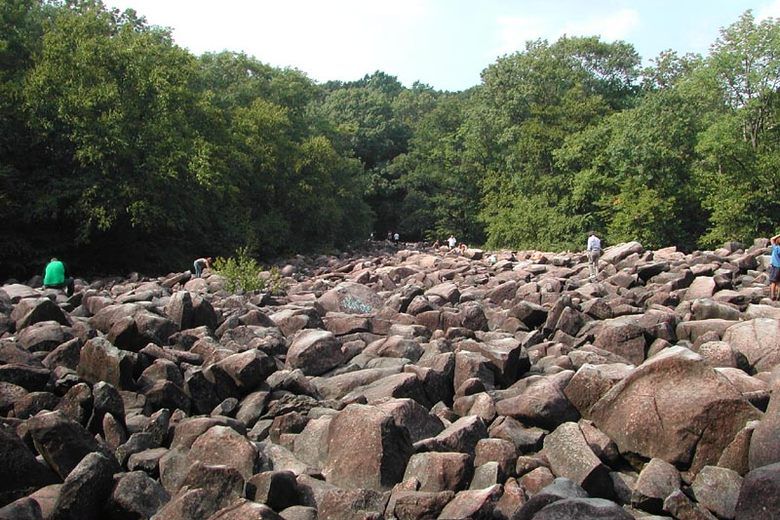
Imagine a forest clearing where the ground itself sings. In Upper Black Eddy, a massive expanse of igneous rock defies the typical silence of a geological formation, offering visitors a chance to play a literal rock concert on stones that chime like bells.
This isn't just a pile of debris; it is a resonant landscape that has fascinated locals and scientists for over a century.
Why It Stands Out
The history of this site as a musical venue dates back to at least 1890, when a local named J.J. Ott performed a set for the Buckwampum Historical Society using nothing but these resonant stones and a hammer.
Spanning seven acres and reaching depths of ten feet, this field is a geological anomaly. Another geological quirk can be found at Proxy Falls.
While the entire field is composed of similar material, only about one-third of the boulders produce tones audible to the human ear. Scientific investigations in the mid-1960s revealed a fascinating secret: while all the stones vibrate when struck, many do so at frequencies far below our hearing range.
The exact reason for this sonorous quality remains a subject of debate, though some researchers point to the unique internal stresses created during the freeze-thaw cycles that originally formed the field. Interestingly, local lore suggests that these rocks lose their musical properties if removed from the site, making them a treasure that can only be experienced in situ.
Before You Go
To experience the phenomenon yourself, you must come prepared with your own hammer or a mallet, as the park does not provide tools. Wear sturdy, closed-toe shoes suitable for scrambling over uneven, often sharp-edged boulders.
The field is surrounded by a lush wooded area, providing a sharp contrast to the grey, barren expanse of the rock pile. Remember that removing any stones from the park is strictly prohibited; they belong to the collective landscape and supposedly go silent once separated from their companions.
Human interference also threatens the delicate Morning Glory Pool.
Questions worth answering
What's the best way to get a sound out of the stones?
You'll need to bring your own hammer or a mallet since the park doesn't hand them out. Strike the rocks to hear the metallic chimes, but keep in mind only about one-third of them ring at a pitch humans can actually hear.
Is it safe to walk across the field?
The terrain is a seven-acre expanse of sharp-edged, uneven boulders. Wear sturdy, closed-toe shoes if you plan on scrambling over the rocks.
Can I take a small rock home as a souvenir?
Removing any stones is strictly forbidden. Local legend claims they lose their musical voice anyway once they're taken away from the rest of the field.
Why do some boulders stay silent when I hit them?
Only about a third of the field produces tones we can hear. While every stone vibrates when struck, many do so at low frequencies that fall outside the range of human hearing.
More in Northeast
All Northeast places →
Centralia
Aristes, Pennsylvania
This former mining hub sits atop a subterranean coal fire that has burned since 1962, turning a once-thriving community into a grid of empty streets reclaimed by nature.

Brooklyn Botanic Garden
Brooklyn, New York
This urban sanctuary offers a jarring contrast between the delicate beauty of cherry blossoms and the rare, putrid stench of the Titan Arum, one of the world's largest and smelliest flowers.
Roosevelt Island Tramway
New York, New York
This sky-high transit link is a true American rarity, serving as one of only two aerial tramways in the nation designed specifically for daily commuter use.